Coverage & Needs
Mortgage life insurance vs. term life insurance in Canada
Bank mortgage life insurance pays a shrinking benefit to your lender; term life pays a level benefit to whoever you name. What the FCAC comparison table and the banks' own certificates actually say — and the narrow cases where creditor coverage still wins.
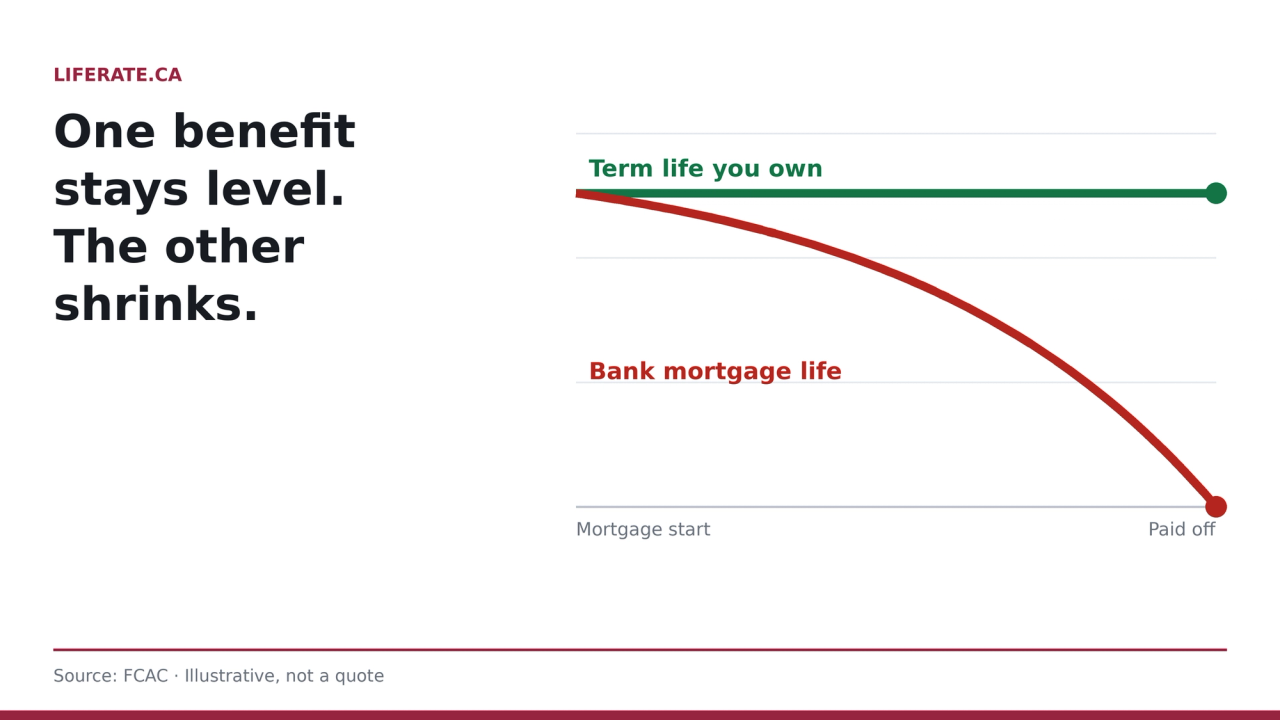
Mortgage life insurance vs. term life insurance is really a comparison of two different answers to the same fear: what happens to the house if you die. Mortgage life insurance — the coverage offered at the bank when you sign or renew — pays whatever is left on your mortgage to your lender. Term life insurance pays a level amount you chose to a person you named, who can use it for anything, including paying off the mortgage.
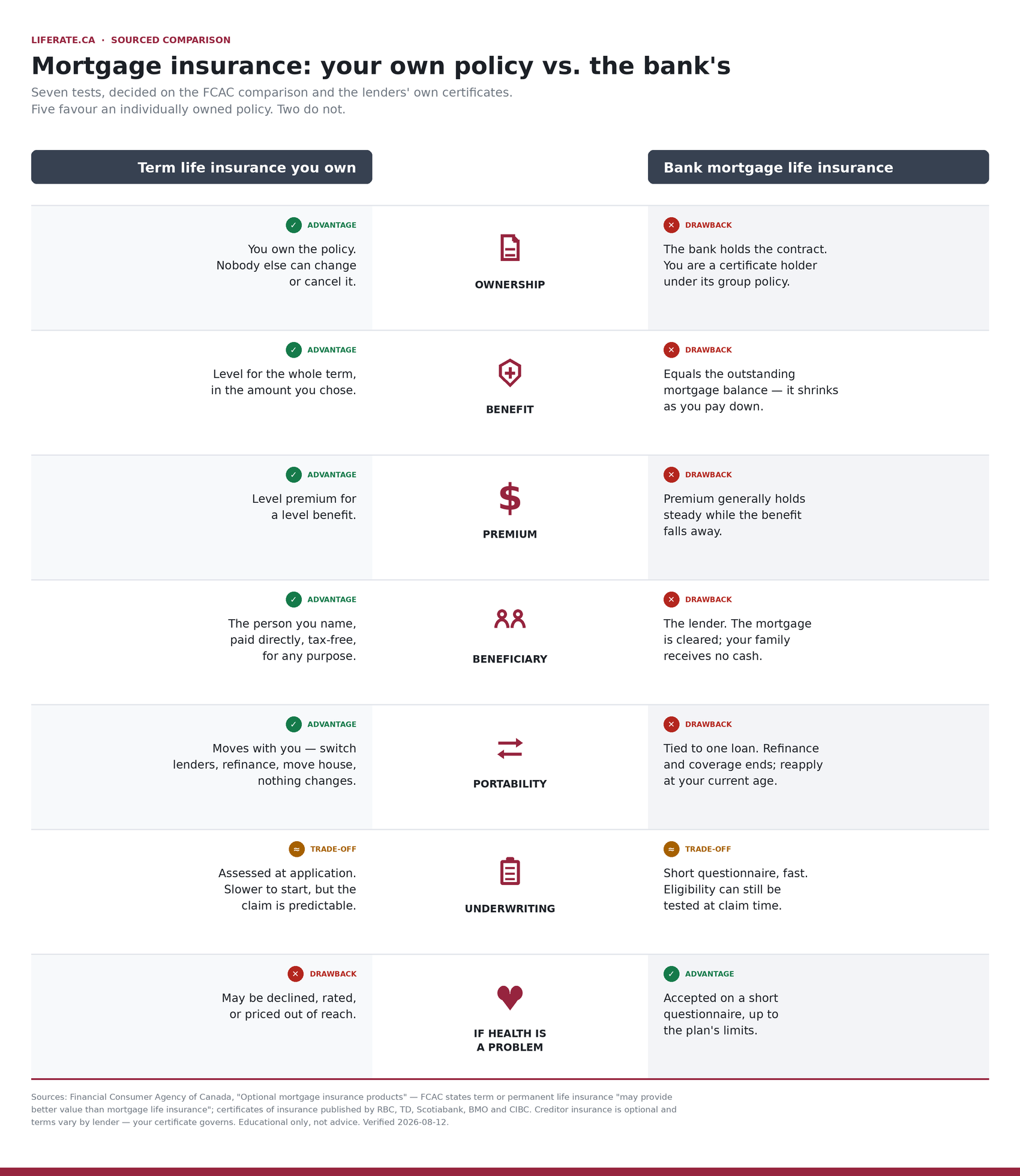
That one difference — who receives the money, and how much — drives nearly everything else. The Financial Consumer Agency of Canada (FCAC), the federal consumer regulator, states in its own guidance that term or permanent life insurance "may provide better value than mortgage life insurance." This article walks through what FCAC's comparison table and the banks' own certificates of insurance actually say — and is honest about the narrow situations where the bank product still wins.
One disambiguation first: mortgage life insurance is not mortgage default insurance. Default insurance (from CMHC, Sagen or Canada Guaranty) protects the lender when your down payment is under 20% and can be mandatory. Mortgage life insurance is always optional — FCAC is explicit that the lender cannot insist you buy it and must obtain your express consent.
What mortgage life insurance in Canada actually is
Despite the name, mortgage life insurance is not an individual policy. It is creditor's group insurance: your bank holds a master group policy with a life insurer, and when you sign up you are enrolled as a member of that group and receive a certificate of insurance. In Ontario, that structure comes straight from the Insurance Act — the bank is the group policyholder; you are an insured debtor under the bank's contract.
The insurer behind the product usually isn't the bank. Based on the certificates each bank publishes, Canada Life underwrites the mortgage life coverage sold by RBC (HomeProtector), TD, Scotiabank and CIBC. BMO's current product is underwritten by Canadian Premier Life Insurance Company, operating as Securian Canada. Four of Canada's five biggest banks sell mortgage life insurance carried by the same insurer — worth knowing if you assumed you were diversifying by choosing a different bank.
Enrollment is deliberately simple. You answer a short set of yes/no health questions. Answer "no" to everything and you are typically approved immediately; answer "yes" to any and the insurer reviews your application before coverage takes effect — so there is real underwriting at application for anyone flagged by the questionnaire. Coverage maximums are set by each bank's group policy: TD's certificate caps life coverage at $1,000,000, CIBC's at $750,000.
What term life insurance is
Term life is an individual policy you own. You choose the coverage amount and the term — commonly 10, 20 or 30 years — and the insurer underwrites you at application, through health questions and sometimes a paramedical exam. Once approved, the death benefit is locked. FCAC's plain description: the benefit stays the same for as long as the policy is in force, and your beneficiary may use the money for any purpose.
Because you own it, the policy has nothing to do with your lender. Switch banks, refinance, move houses, pay the mortgage off early — the coverage continues untouched. Most Canadian term policies are also renewable at the end of the term and convertible to permanent coverage without new medical evidence. (How mortgage terms, renewals and amortization themselves work is its own subject — our sister site TermRates.ca covers the mechanics.)
The other structural advantage: term coverage is sized to your actual need, not your mortgage balance. Income replacement, childcare, other debts, final expenses — the mortgage is usually only one line of that calculation.
Mortgage life insurance vs. term life: the four differences that decide it
1. A shrinking benefit for a level premium
FCAC's comparison table states it directly: the mortgage life death benefit equals your outstanding mortgage balance and decreases as you make payments, while premiums generally stay the same. You pay the same every month for less and less coverage. A term policy inverts that: level premium, level benefit, from the first month of the term to the last.
2. The money goes to the lender, not your family
In FCAC's words, "the mortgage lender receives the death benefit, not your family or heir(s)." Your family gets a paid-off house — real value — but no liquidity for income, childcare, or anything else. With term life, your named beneficiary receives the full benefit, tax-free, and decides what to do with it. Paying off the mortgage remains one of their options; it stops being the only one.
3. It doesn't move with you
Creditor coverage is tied to a specific loan at a specific lender. RBC's HomeProtector certificate says that if you refinance or add on to the insured mortgage, "coverage terminates and you must reapply" — with premiums recalculated at your age at that time. Every refinance and every lender switch is a new application, at a higher age, with your health as it is then. An individually owned term policy simply doesn't care who holds your mortgage.
4. Post-claim underwriting: when your health is actually assessed
This is the difference behind most of the horror stories. With term life, underwriting happens at application: the insurer assesses your health, then issues the policy, so a paid claim is far more predictable. With creditor insurance, the questionnaire is short and approval fast — but eligibility can be verified when a claim is made. Scotiabank's certificate puts it starkly: a premium debited from your account "does not make insurance effective if You are otherwise not eligible." FCAC's warning is the same — the insurance won't be valid if the health answers weren't accurate — which is why FCAC suggests taking the forms home and consulting a medical professional before answering.
To be fair about scale: this risk concentrates in inaccurate questionnaire answers. Applicants who answer "yes" are reviewed by the insurer up front, new enrollments at CIBC and Scotiabank come with a 30-day review period and full refund, and claims are paid — RBC's own material references its paid-claims data. But the structural point stands, and it was the subject of CBC Marketplace's "In Denial" investigation back in 2008: a product whose eligibility is confirmed after death protects less predictably than one underwritten before.
Is mortgage insurance worth it in Canada? What the numbers say
The banks publish their rate cards, so use them. CIBC's mortgage life brochure prices coverage per $1,000 per month by age band: $0.08 under 30, $0.20 at 36–40, $0.43 at 46–50, rising to $0.97 at 61–64. CIBC's own worked example: a 36-year-old insuring $150,000 pays $30.00 a month — for a benefit that shrinks toward zero as the mortgage is paid down.
Term comparators from the carriers' own pages at time of writing: RBC Insurance quotes roughly $19.85 (female) to $25.78 (male) per month for a healthy 35-year-old non-smoker buying $350,000 of 20-year term. Scotiabank's own insurance arm advertises term from $10.58 a month for $250,000 (30-year-old healthy female non-smoker, Term 10). Similar money, roughly double the coverage, level instead of declining — and paid to your family instead of the bank.
Every figure above is age-, health- and date-sensitive; carriers reprice, and we re-verify against the cited documents at publication. The method matters more than the snapshot: pull your bank's rate card, get a term quote for your age and coverage amount, and compare the cost per dollar of coverage. For most healthy applicants, that comparison is not close.
When mortgage life insurance still makes sense
A blanket "never buy it" is bad analysis. Creditor insurance earns its place in three situations:
- Insurability problems. If your health would make individually underwritten term unavailable or heavily rated, truthfully answering "no" to a short questionnaire and being accepted up to the bank's maximum can be the better — sometimes the only — protection available.
- Speed at closing. Coverage can begin the day the mortgage funds, with no exam and no wait for underwriting.
- As a bridge. Some buyers take creditor coverage at closing, apply for term immediately, and cancel the bank product once the term policy is in force — the 30-day review period on new enrollments can even make the first month fully refundable.
How to replace creditor insurance safely
- Apply for the term policy first, and wait until it is fully in force — approved, issued, first premium paid.
- Only then cancel the creditor coverage. FCAC confirms credit and loan insurance can be cancelled at any time.
- If a cancellation or claim dispute can't be resolved with the insurer, the OmbudService for Life & Health Insurance (OLHI) handles unresolved complaints free of charge.
Never let the old coverage lapse before the new policy is actually issued. A coverage gap — or a decline on the new application after you've already cancelled — is the worst outcome on the board.
Who's advising you at the branch
One structural point worth understanding: the person offering mortgage life insurance at the branch is enrolling you under the bank's group policy. That is administration of a group product, not individual insurance advice — Ontario doesn't require an insurance licence for the role because group enrollment isn't "acting as an agent" under the Insurance Act. A licensed life insurance advisor, by contrast, is trained and regulated to assess your overall needs across products and carriers. Neither is wrongdoing; they are different jobs. But the comparison this article describes — how much coverage, what type, from whom — is the licensed conversation.
The honest summary: mortgage life insurance is a convenience product with a real but narrow use case, and term life insurance is the structurally better instrument for most households protecting a mortgage. Which one fits your situation — and how much coverage the rest of your life actually requires — is a conversation for a licensed life insurance advisor. This article is educational, not individual advice. Primary sources are linked throughout, and every figure is verified against the cited documents as of publication.